Archive | Start-ups RSS feed for this section

an Uber move…

29 Jul


Today marks the beginning of the next chapter of my career. After 3 years of consulting and 1.5 years of private equity, working for large, brand-name, established companies, I’m taking the leap to start-up world and joining Uber. In my opinion, Uber is one of the most disruptive, beloved (just search Twitter for @Uber!), and exciting companies in the market right now and I am thrilled to be joining the team! I will be serving as the Chicago Operations Manager and helping to launch service here in the Windy City. With harsh winters, a rickety and nearly bankrupt public transit system, a near-universal cabbie allergy to credit cards, along with a hot foodie and nightlife scene, five major professional sports teams and two international airports, the need and value proposition for Uber Chicago is clear.

I’m super energized to dig in with Uber. I think the team is building a new and truly transformative local transportation solution and I’m fired up to help bring that to Chicago with the unique experience, data, and customer service that Uber has come to stand for. It’s game time!

iMoney – A New Business for Apple

12 Jul

One of the spaces I’m most excited about right now is mobile payments. The idea of untethering us from a physical wallet by leveraging the power and ubiquity of our mobile phones is a vision that many established companies and start-ups alike are pursuing. It’s no wonder either, given the size of the market opportunity – as a single data point, in 2009, Visa processed $4.4 trillion(with a T) dollars of transactions, and the electronics payment industry as a whole is growing at an estimated 12% CAGR. So, yeah, it’s a big pie and everyone grabbing for a slice.

There are many competing approaches currently in the marketplace. While the execution of the strategies varies, they are all generally built on the existing payments infrastructure of Visa/Mastercard/AMEX. A few examples are:

  • Google Wallet, which runs on Near-Frequency Communication (NFC) chips implanted in the hardware of the phone and allows contactless payments using your phone as a credit card. Partnership with Citi Mastercard and Sprint at launch.
  • Isis, a partnership between AT&T, Verizon, and T-Mobile, is also pursuing a mobile wallet approach that leverages the Visa, Mastercard and Discover payments networks
  • Square, the newest member of the $1 billion start-up club, which turns your iOS or Android mobile device into a payment terminal via either a small hardware fob or an app. Using Square just feels like the future!
  • One of my favorite products right now is Venmo, a mobile and web application that allows amazingly easy and fee-less peer-to-peer payments. By attaching your credit card and bank account information, you can pay your friend for a beer using your credit card through your phone. The funds will then be deposited into his bank account within 1 business day.

Certainly at this point it’s difficult to predict which companies will become preferred solutions (and the market is so big there are opportunities for many winners, particularly when you begin to parse C2B enterprise from C2B small biz from peer), but one company that I would like to see be more active is Apple. Given that it has 200 million credit cards (2x Paypal), completely integrated hardware and software (including a browser), and deep experience handling transactions at scale (15 billion app sales), running an payments network would be a natural extension. Perhaps dubbed “iMoney?”

The concept is simple – use your iMoney (nee iTunes) account, which already contains your credit card information, to pay for purchases all over the web. Apple has a built in head-start given its cache of credit card data (the same moving start would go, to a lesser degree, to Amazon and Groupon as well, each of whom also has millions of credit cards on file) and could easily leverage this information to allow users to pay businesses and each other by entering nothing more than an iTunes password. At present I have to enter my credit card information for every unique transaction I make across the web (and each time I register download a new mobile app) – iMoney could elegantly address this. Beyond allowing “one-click” buying on sites that accept iMoney, Apple could integrate iMoney into its iOS, much in the way it is baking in Twitter. Done right, this could have a large impact on the “app world” we’ve all come to live in. At the most basic level, it could eliminate a step of app setup whereby I register the same credit card for every e-commerce app I download. Rather, in the same way that I authorize the app to use my location data at download I would also authorize it to connect to my iMoney account. Thinking further down the road, it could make mobile web transactions much more appealing by reducing the required data input to consummate a transaction. This could be the beginning of the end for the “proprietary app centric universe” we currently live in, as Fred Wilson describes it, because iMoney has the potential to make mobile web purchases as easy and one-click as app purchases.

Given that I hate paying cash and write exactly one check per month, I love the current innovation in electronic payments that smartphones are facilitating. With Apple showing no signs of relinquishing its status as the smartphone that all competitors chase, it would surprise me if they didn’t build upon their formidable iPhone/iTunes base to enter the payments race. I, for one, would welcome it.

Check-in to this T-Shirt: The Foursquare Store

6 Jul

Last week I unlocked the “Ten Hundred” badge on Foursquare.

Over 1000 check-ins!? Thank you 1000 times over! Treat yourself to 40% off some cool shirts at foursquarestore.com (use the code 4SQ40-4F365-F5B69). We’d give you 1000% off, but that don’t make no sense! It’s a super tiny gesture of our immense appreciation.

While I’m always excited to unlock a badge (yep, 2 years later, the badges still do it for me) the text associated with this badge really intrigued and impressed me with how Foursquare thinks about themselves as a brand and engages their most loyal users.

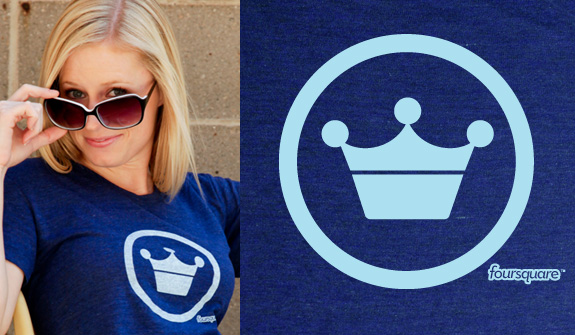
First of all, I didn’t even know that Foursquare had a store. While this is interesting in and of itself, the idea of promoting that store by offering your customers a loyalty discount is an even better idea. It should come as no surprise that a company as focused on the relationships between brands/businesses and customer actions would tie their own company brand to customer loyalty. Foursquare rightly assumed (as that shirt above is now in my tshirt drawer) that any user who used the service 1,000 times would be enough of an evangelist to consider buying a shirt – particularly with a discount. (There are also a couple other interesting things going on here – limited time shirts related to different badges, user voting to select the next tshirt design, etc). However, when I investigated further, I couldn’t find a similar store for Facebook, Twitter, or Apple. In fact, Google was the only company I searched for that had a store.

I think this is a brilliant move by Foursquare to (a) reward its most loyal users with a “hey, thanks!” (b) monetize those very same customers and (c) enlist its a portion of its 10 million strong army of users to become walking billboards. As hot as cool Ts continue to be as fashion items (particularly th0se ultra-comfortable American Apparel ones!), this is low-hanging fruit for companies with beloved products to both reward their most active users while generating some easy revenue.

This isn’t a new strategy – the best consumer brands have been employing this strategy for years (how many of you athletes had Gatorade tshirts in middle/high school?). However, it is really only in the recent “social media” era that tech brands have focused on cultivating empassioned users. So go on, cool start-up, print up a few tshirts or better yet, partner with someone like Threadless to allow your users to submit some awesome designs, and start rewarding your most loyal users (You do know who your most loyal users are, right?) with some sweet swag!

Talk back: Which companies do you love enough to rock a tshirt from?

[Update, apparently the Foursquare store has been open for business since August of 2010. Business Insider’s article indicates that some items may only be available to users who unlock certain badges, which is another great way to incent purchases through perceived scarcity]

Live Sets & Release Parties – Turntable.fm as a (legal) Business

27 Jun

As a music junkie, one of my favorite companies right now is turntable.fm, the collaborate music DJing and listening site that allows you to listen to music with your friends, chat, and try to accumulate enough points to upgrade to a sweet DeadMau5 avatar (below).  

According to reports last week, the service has now accumulated 140,000 users in its first month. By all accounts, Seth Goldstein and Billy Chasen have really created something compelling here. By combining elements of social (chat rooms are cool again!), music discovery, and gaming, its the most fun I’ve had listening to music in a long time. However, as Turntable grows in popularity, the key question, as Peter Kafka asked last week, will very quickly become “is it legal?” I’ll leave that debate for others more familiar with the Digital Millennium Copyright Act and the intricacies of music licensing than I, however, assuming the lawyers can work out a solution to keep Turntable spinning, I believe the business potential for the site is tremendous.

As The Next Web pointed out in a post over the weekend, the service has a number of future directions that would not only expand its platform and usefulness to users, but generate meaningful revenue. These include:

  • Customizable and branded rooms
  • Celebrity guest appearances
  • Audience engagement by media companies

I completely agree with these opportunities and they are already materializing. Silicon Angle reports that such companies as Gowalla, Path, Zaarly, and Vaynermedia already have a presence on the site. In fact, I became aware of Zaarly as a service through interaction on Turntable.fm, when they tweeted to invite me into their room. Music is a powerful tool through which brands can interact with their audiences and there will be no shortage lining up to do just that via Turntable – IF they can keep their legal house in order. As we saw in the early days of YouTube, advertisers are skittish about placing their brand against content of questionable legality.

However, I think that another significant business opportunity for Turntable would be to engage with the very same music labels and publishers that may question this legality. Turntable could be a powerful tool for bands themselves to engage with their fans. Imagine getting an email (as Turntable’s “fan” feature currently allows) that your favorite band is having an album release party for their new record in a Turntable room. Or that you could catch the debut of the latest mash-up track from Girl Talk. Or that Foster the People (check these guys out if you haven’t yet – they’ll be huge) will be hosting a replay of their latest sold-out live set that you couldn’t get tickets to. And that you could chat with the artist during the event. And that all your friends could (virtually) go. You’d pay for that right? I know I would.

As the $400 million of investment in music start-ups this year indicates, lots of smart people think the music industry isn’t dead as a profitable business. In fact, Rick Rubin. former co-Chairman of Columbia Records recently stated that “the music business could be bigger than ever.” I certainly agree, but it will require the labels and publishers to finally accept that their model has irrevocable evolved and start thinking about companies like Turntable as a giant opportunity to make money, and not a threat. As I tweeted last week, if the music industry establishment chooses the latter, they truly have no vision for the future of music in the digital era. And that future looks a lot like Turntable.fm

Fan me on Turntable.fm: DJ AP

[Update (7/6/2011): Music + Fashion site One Band One Brand recently held a marketing event in a Turntable.fm room that includes trivia contests and giveaways: http://www.hypebot.com/hypebot/2011/06/1band-1brand-holds-turntablefm-party.html. Look for more of this!]

In defense of Twitter…

28 Mar

Who wants to read more about Twitter??

Probably, at this point, no one.  Twitter has received an abundance of press recently, discussing everything from its growth, to who is tweeting on behalf of celebrities, to how the site will ever make money.  While overwhelming, this chatter is probably justified given the site’s tremendous growth over the past year (see below).

There is clearly no questioning the growth of Twitter, however I know many users that struggle to find value in the site or resist the movement of even more social communication.  Let’s address these one at a time.

First, the value of Twitter.  The common question I get is “what makes this different than Facebook status messages?”  Fair question.

My perspective is that, when used properly, Twitter allows you to cut through the noise of Facebook and truly keep up with what those you are following are sharing, thinking, and asking.  Notice I did not mention “doing,” as Twitter asks; this was intentional.  I find the most value in Twitter by finding useful (e.g. informative, amusing, etc.) links shared by those I trust and value enough to follow, asking questions of those who follow me, and keeping a real-time pulse on the thoughts and feelings of those I am closest to.

Most of these people I know offline.  Some I don’t.  Regardless, they bring something valuable to my community that I have created and, by virtue of this value, I choose to continue to follow them.  The number of folks I follow is increasing regularly, but thoughtfully.  To maximize the value of Twitter, the “less is more” principle applies.  For a case study on that, see the following post from ryanagraves.com.

To draw an analogy, Facebook is a crowded bar with all your friends, acquaintances, work colleagues, rec softball team, roommates, and a bunch of strangers.  Twitter is (or SHOULD BE) a party at your apartment.  In the former you have brief conversations with everyone, but don’t remember any of it the next day (not because of the booze, just the volume!); in the latter you use the arena to drive deeper engagement, asking follow-up questions, initiating a dialogue, and following up the next day.  Its the same reason I find house parties to be the best venue to meet girls – look for more on this in a future post.

The other key difference between Facebook and Twitter is access.  With Facebook, you have to accept my friendship.  While I truly doubt that President Obama is “friends” with 5,993,692 people (as of 3/28/09 2:19pm CDT), this utility still requires mutual interest.  Twitter, on the other hand, allows free-reign following.  I find you, I follow what you post.  Its that simple.  This has provided an unprecedented stage for celebrities, brands, and me to broadcast to the entire community.  It also complicates the “less is more” precept; as such, follow carefully!

Next, why Twitter is not the next step in the demise of interpersonal communication.

To illustrate my point, see if you agree with this statement:

“the more you learn about someone, the closer your relationship with them becomes”

So, we’ve got some heads nodding now, I hope.  Its inherent that as you get to know someone better – through communication, knowing their interests, what is important to them, how they spend their time – that you become closer to them and, generally, want to learn more.

To me, this further speaks to Twitter’s strength.  As I read the questions you tweet, the links you share, and your reactions to daily life, I learn more about you.  As I learn more about you, I want to dive even deeper and, ideally, choose escalate this conversation.  I may tweet a follow-up or bring it up the next time we hang out.  We can discuss the article you shared, add greater depth to an online conversation, or simply talk about a common interest discovered via our following of one another.  Regardless, real, genuine, communication has occurred, driven by Twitter.

In short, contrary to the belief that the web has destroyed interpersonal communication through its substituted goods of email, IM, blogging, and social networking, I would argue that it provides a greatly enhanced ability to communicate with more frequency, timeliness, and, when taken offline properly, greater depth.  Don’t believe me?  Ask your parents how often they talk to their friends and how attuned they are to their daily challenges and successes.  If they aren’t utilizing the above-mentioned tools, I’d wager to say they may lag behind your connectivity.

In conclusion, I have a confession.  I joined Twitter, just this past February, because of the buzz.  I work in strategy consulting for entertainment and media companies and the buzz had become so strong that I had to learn more.  Like many, I entered with much skepticism and continually refine my thoughts about how I want to use Twitter.  While, I am not sure I have fully refined my use-case yet, I now am confident that I am:

1) More focused in the social networking space (less time reading Facebook status’ of my roughly 700 friends),

2) More deeply connected to those friends of mine who I follow on Twitter – both online and offline, and

3) Making efforts to add value to those who choose to follow me.

If nothing else, take the old “try before you buy” challenge.  Sign in, start reading (with these guidelines in mind, of course!), and see if you agree.

Tips to maximize Twitter use:

1. Less is more – be selective about who you follow.  This doesn’t mean it has to be a small number (but, this is a good sanity check – tough for 500 people to truly add that much discrete value), but if they don’t add value to your time spent reading their posts, unfollow them and keep up via Facebook.

2. Take advantage of the access.  Think Dwight from The Office is funny, follow him.   Curious what John McCain has been up to since his November “L”, follow him.  Its democracy in action, folks!

3. Use it to learn more.  Be an participant.  Post, reply, ask questions of followers, take online conversations off-line.  Don’t make my praises of social media’s positive impacts ring hollow.

Follow me on Twitter: @AllenPenn